




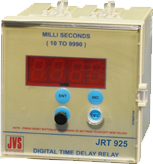
Description
DTDR reset operation in mode – “0100”: “0100” mode corresponds to “Hand Reset” mode. The NO contacts of the DTDR will remain in operated state until further human intervention. Following the operation (NO – > C) of DTDR contacts, DTDR can be reset by pressing “RESET” (RST) switch on the DTDR.
DTDR reset operation in mode – “0200”: “0200” mode corresponds to “TYPE-1 Self Reset” mode. Following the operation (NO -> C) of DTDR contacts, a “self reset timer” will start decrementing from a value equal to “Reset time delay”. When this “self reset timer” reaches its terminal count (‘0’), DTDR is reset.
DTDR reset operation in mode – “0300”: “0300” mode corresponds to “TYPE-2 Self Reset” mode. Following the operation (NO -> C) of DTDR contacts, DTDR transits to a wait state where it waits for the “Timer Initiation Contact” across [6,7] to change its state from “closed state TO Normally open state”. When “Timer Initiation Contact” across [6,7] changes state from “closed state TO Normally open state”, a “self reset timer” will start decrementing from a value equal to “Reset time delay”. When this “self reset timer” reaches its terminal count (‘0’), DTDR is reset.
Application:
Digital time delay relay is used to provide delay in a circuit
Ratings
| Auxiliary Supply | Less than 4W (Non Operated) Less than 5W (Operated) |
Settings:
| Time delay setting | 10 to 9990ms in steps of 10ms |
| Reset time setting | 10 to 9990ms in steps of 10ms |
| Mode of operation | 0100 – Hand reset 0200 – TYPE-1 SELF RESET MODE 0300 – TYPE-2 SELF RESET MODE |
| 2 – shot STD Reclaim time | 200 – 300s in steps of 1s |
| Dead Time 1 | 10s – 60s in steps of 1s |
| Dead Time 2 | 30s – 180s in steps of 1s |
| Fast reset | 0 – 15 s in steps of 1s |
| 2 – shot Reclaim time | 1 – 255s in steps of 1s |
| Dead Time 1 | 0.25s – 60s in steps of 0.25s |
| Dead Time 2 | 0.25s – 60s in steps of 0.25s |
| 1 – shot Reclaim time | 6 – 69s in steps of 1s |
| Dead Time 1 | 0.1s – 1.6s in steps of 0.1s |
Accuracy:
| Operating value | ± 0.5% or ± 20msec |
Burden:
| Aux. Supply | Less than 5W (Non Operated) Less than 7W (Operated) |
Contact Ratings:
| Output Contacts | 5A at 24V DC / 230V AC |
| Contact | 2NO / 4NO |
Contact Durability :
| Unloaded contact | 1,000,000 Operations. |
| Loaded contact | 00,000 Operations |
Mechanical Design :
| Weight | Appx. 500 gms |
| Case Size Fascia | 96 mm sq, Depth 105mm |
| Installation | Flush mounting |
| Panel cutout | 92×92 mm |
Ordering Information
| Relay type | JRT 125 – 2NO JRT 145 – 4NO |
| Aux. Supply | 20 to 60V DC 80 to 260V AC / DC |
Reviews
There are no reviews yet.